We have all been there. You are sitting in your room, hands glued to a controller or keyboard, playing an indie game with a beautifully minimalist aesthetic. The screen glows with chunky, stylized textures. Suddenly, a wave of intense, unearned confidence washes over you. “I could totally do that,” you whisper to yourself. “It is just colored squares. How hard could it be?”
Meet hby, a generalist pixel artist who fell headfirst into that exact trap. Spoiler alert: it is actually very hard. But luckily for us, hby didn't give up when the colored squares started fighting back. Today, they are creating some of the most lush, atmospheric environment art on the internet. We sat down with them to talk about their journey from overconfident gamer to master of the overgrown post-apocalypse, their chaotic creative process, and why drawing from memory is a fast track to hilarious disaster.
From "This Looks Easy" to "Oh No, There is Math"
Like many artists in the digital space, hby’s origin story begins with a spark of indie game inspiration. Specifically, a psychological survival horror game.
"I originally got into pixel art because I thought it was an easy and quick way to make game art," hby admits. "I played a game called Lone Survivor and thought, 'I could totally do that.' But the more I tried, the more I realized how much more depth there was in the medium."
It is the classic artist’s paradox: the simpler a style looks, the more deliberate every single pixel must be. When you only have a canvas of 64 by 64 pixels to convey a dramatic forest or a moody sunset, a single misplaced dot can turn a majestic pine tree into a green blob of static. Instead of running away from this sudden realization of difficulty, hby leaned into it, falling in love with the sheer precision of the grid.
That search for a community to share this newfound obsession led them to a platform that felt both entirely modern and delightfully retro.
"I stumbled across Pixilart randomly," hby says. "At the time, I was trying to grow an audience and was posting anywhere I could find. Pixilart was fascinating to me: a highly curated gallery but at the same time a true social media, kind of like Pixel Joint meets MySpace, but with a real, substantial user base."
For anyone who remembers the wild west of early-2000s profile customizing, that comparison hits close to home. It is that exact blend of community-focused interaction and artistic playground that keeps creators like hby posting and evolving.
The Art of Finding Yourself in a Blob of Pixels
If you scroll through hby’s gallery, you’ll quickly notice two recurring themes: the quiet beauty of overgrown, post-apocalyptic ruins, and the sparkling mystery of the deep cosmos. Think less Mad Max and more Nature reclaiming the concrete jungle under a canopy of quiet stars.
So, where does this inspiration come from? The answer is surprisingly analog: stepping outside.
"Summertime is always great and full of inspiration," hby says. "Some of the artwork that I'm most proud of came directly from taking walks in nature."
But turning those real-world nature walks into pixel-perfect environments isn't a straight line. In fact, hby's creative process is delightfully loose, relying on a bit of creative detective work to find the final image.
"I sketch with lines usually, but if I really have a strong idea for colors or composition, I might go straight to color blocking," they explain. "Once I'm happy with the big idea, it's time to refine. Oftentimes, I don't even know what each random shape is meant to be. The process involves gradually solving their identities."
Imagine looking at a blob of dark green on your screen and spending twenty minutes negotiating with it. Are you a moss-covered boulder? A collapsed steel beam? A giant sleeping frog? Eventually, through the magic of rendering and shading, the blob reveals its true identity.
However, there is one tool that hby has had to force themselves to embrace to avoid those identity crises: references.
"I've been forcing myself to use more references to remind me of the correct appearance of subject matters and to enrich my visual library," they confess. "Often, your idea of what something looks like in your head is totally different from reality. Assumptions can lead to some pretty hilarious mistakes."
We’ve all been there—trying to draw a simple bicycle or a dog from memory, only to end up with a terrifying, biomechanical fever dream. References are the ultimate reality check, even when you are building fictional, post-apocalyptic worlds.
The Love-Hate Relationship with the Grid
Every art medium has its superpowers and its kryptonite. For pixel art, those two elements are often two sides of the same coin.
When asked about their favorite part of the medium, hby points directly to the digital control panel. "The precision makes it very easy to work with. You can replace colors with the click of a button, or use the magic-wand tool to select exact regions that share a color. It is really a huge advantage over regular digital art."
No messy paint-stained jeans, no waiting for layers to dry, and no accidental smearing with your palm. If you don’t like a shade of neon purple, you can banish it from your canvas instantly.
But that same level of microscopic control has a dark side.
"Taking a drawing to its 'finished' state is the most painful part," hby says. "Every single cluster of pixels needs to be looked at and refined. I'm the type of person who just cannot leave things well enough alone."
It is the eternal curse of the pixel artist: the zoom button. When you can zoom in 800% to examine a cluster of four pixels, knowing when to step back and declare a piece "done" is a mental battle of epic proportions.
A Deep Dive into hby's Portfolio
To understand the results of this obsessive attention to detail, let's take a tour of some of hby's standout pieces, complete with the behind-the-scenes stories of how they came to life.
1. Luminance
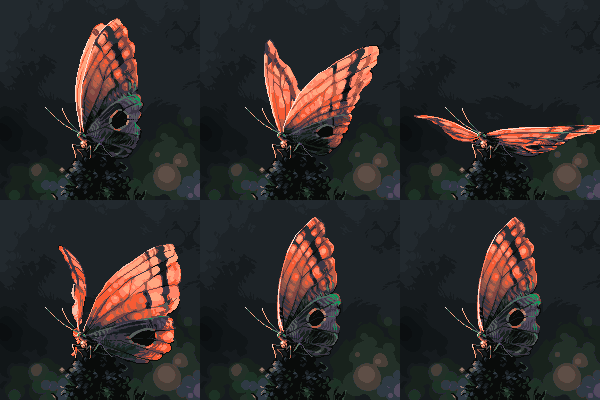
This piece captures a breathtaking, ethereal moment of light filtering through darkness, anchored by a delicate butterfly.
- The Inspiration: "This was inspired by a random frame of a butterfly in some nature documentary-type YouTube video I stumbled on."
- The Triumph: "I tried to give the wings a bit of flexibility. It is not 100% successful, but I'm fairly satisfied with how the attempt turned out."
Luminance is a perfect example of taking a fleeting real-world visual and translating it into a moody, high-contrast digital vignette.
2. Forest
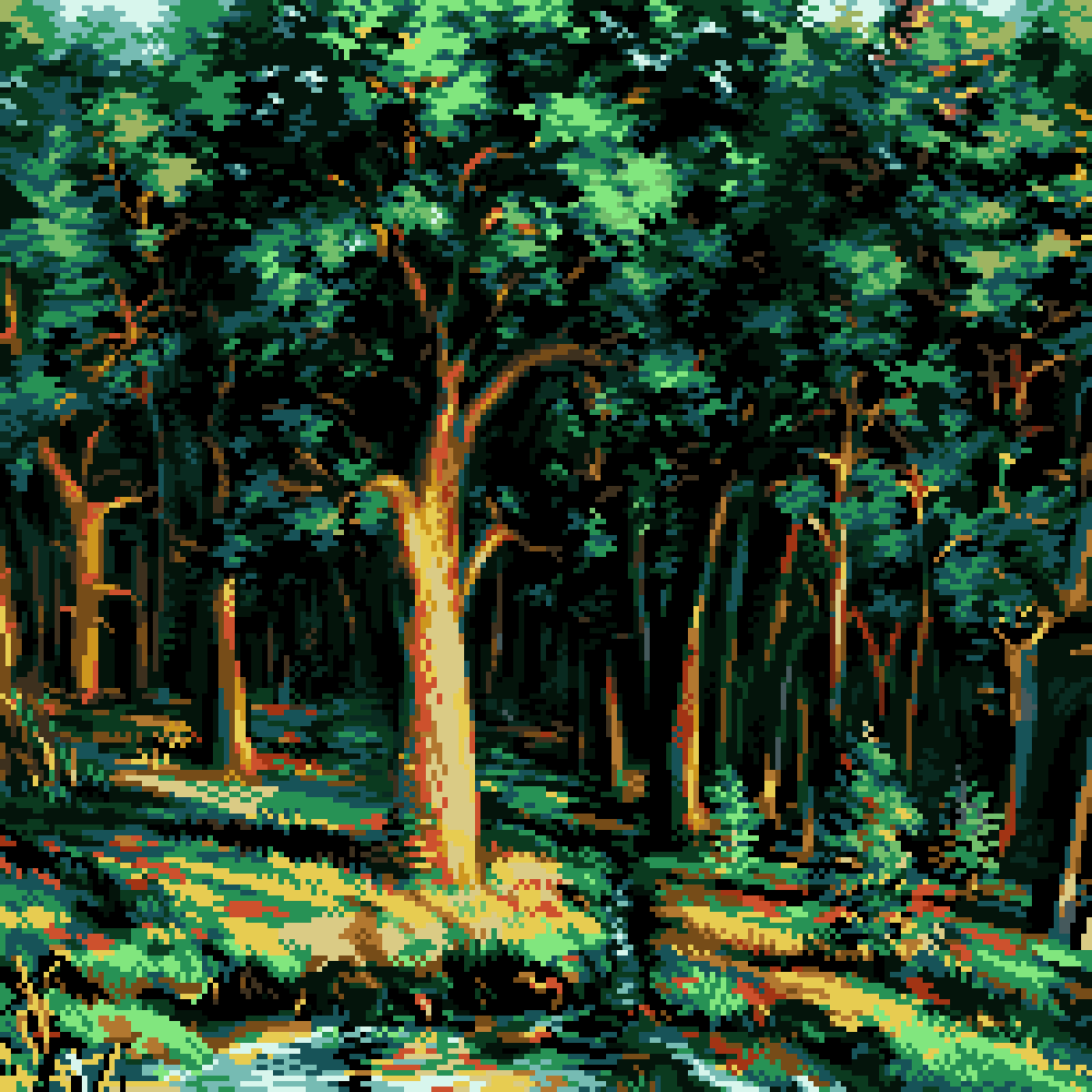
If you have ever wanted to lose yourself in a dense, sun-dappled woodland, this piece is your ticket in. It feels incredibly organic, masking the rigid grid of pixel art entirely.
- The Inspiration: "A pretty obvious imitation of Ivan Shishkin's landscape paintings."
- The Triumph: "I was very happy with the colors, the pixel clusters, and the overall layout."
Mimicking classical oil painters in a digital, low-res format is no small feat. By focusing on cluster shapes rather than individual outlines, hby managed to capture the chaotic, wild texture of a real forest floor.
3. Passengers
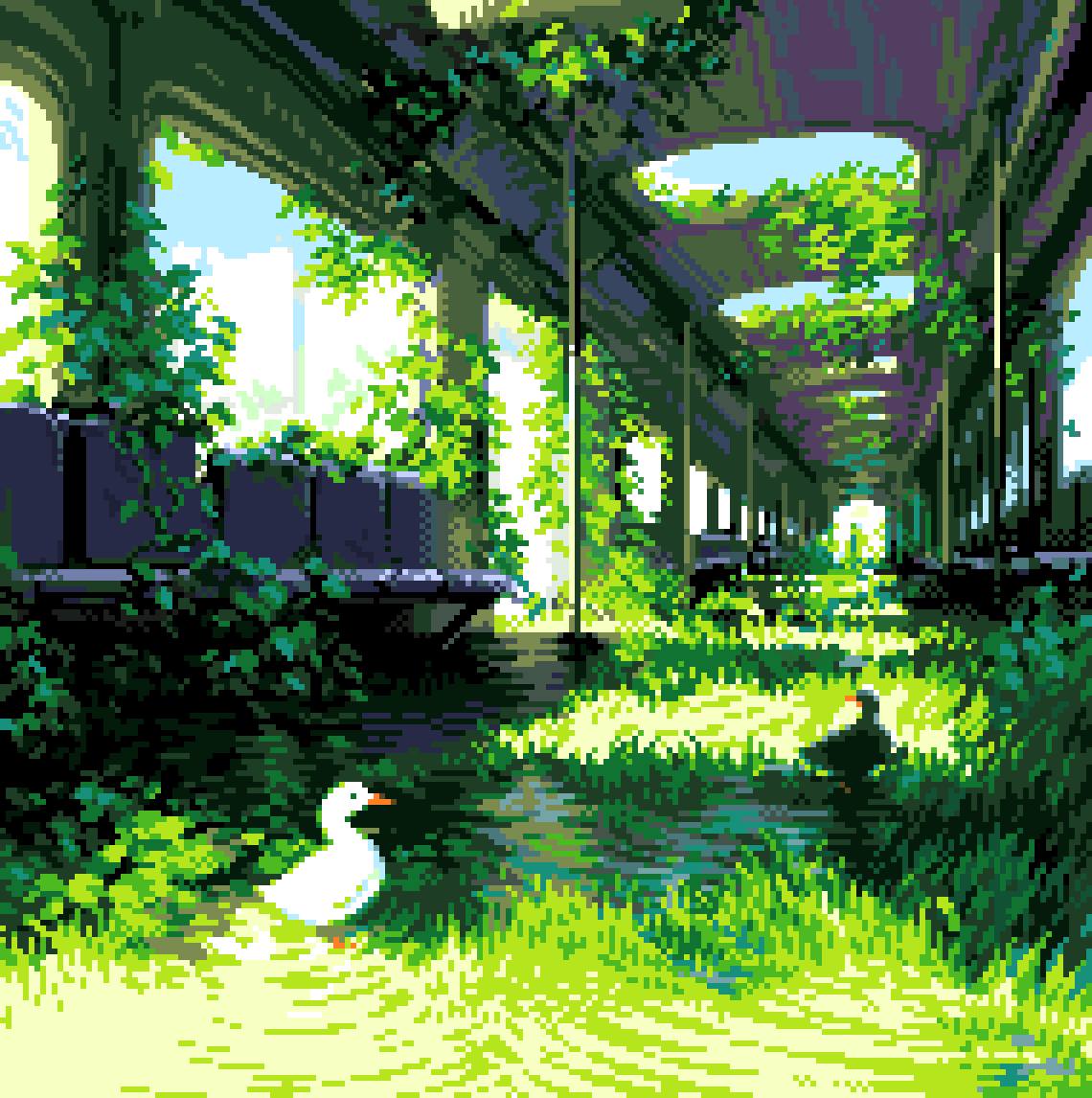
This piece leans heavily into that overgrown aesthetic, featuring a quiet moment where nature and animal life intersect with remnants of the human world.
- The Inspiration: "This was actually one of the very first overgrown pieces where I decided to feature animal subjects as the focal point."
- The Triumph: "I'm very happy with the overall composition and the arrangement of the plant life surrounding the subjects."
There is a deep sense of peaceful storytelling here, making the viewer wonder who these "passengers" are and where their journey is taking them.
The Crown Jewel: The Fallen
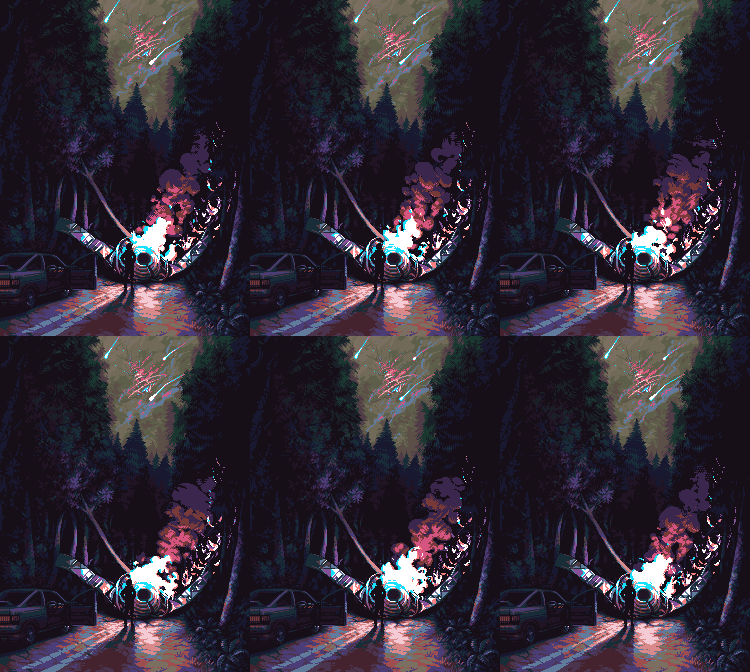
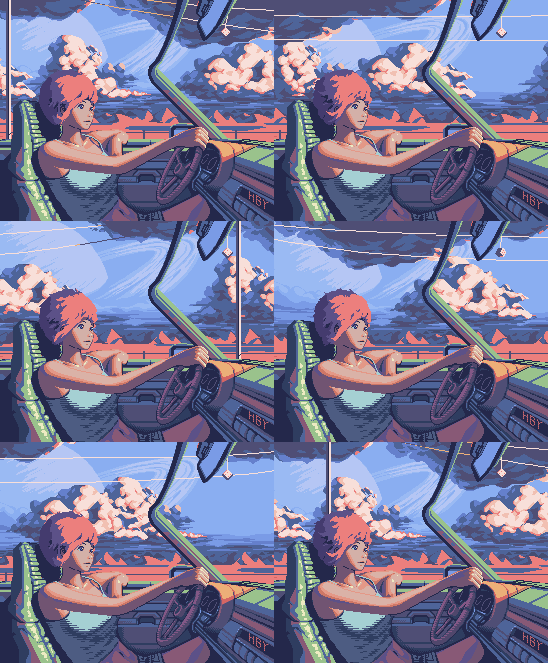
If you ask hby which of their creations they hold closest to their heart, they will point you toward The Fallen. It is a massive, ambitious project that pushed them to their absolute limits.
"This was a huge undertaking and was honestly way out of my skill level at the time—and maybe it still is!" hby laughs. "But miraculously, it worked. There are things I still really don’t like, like some of the clusterwork in the plants, but I'm incredibly happy with the color palette, the composition, and the subtle animation."
The Fallen serves as a monument to what happens when you refuse to let intimidation stop you. It is moody, cinematic, and alive with atmospheric motion—a testament to how far hby has come since their first days of thinking pixel art was the "easy" option.
Leveling Up: Advice for the Next Generation
No matter how accomplished an artist becomes, the journey is never truly finished. For hby, the next mountain to climb involves stepping out of their environmental comfort zone.
"I've been working on improving my colors, my pixel clusters, and my overall composition," they say. "But my main goal is to challenge myself to draw more characters."
To wrap things up, we asked hby for their number one piece of advice for young, aspiring creators lurking on Pixilart, trying to find their own style. Their answer is a masterclass in creative bravery:
> "Challenge yourself. With every single new drawing, try and do at least one thing you’ve never attempted before. Try a new technique, a new type of cluster shading, a completely new palette, a different way to composite, a bigger canvas than you’ve ever tried, or even a smaller canvas than you’ve ever tried. Just keep pushing the boundaries of what you think you can do."
It is easy to stay comfortable. It is easy to draw the same tree, the same character, or the same sky over and over again. But as hby’s stunning portfolio shows, the real magic happens when you dare to look at a massive challenge, shrug your shoulders, and say, "Let's see what happens if I try anyway."
Want to keep up with hby’s gorgeous pixel journeys? Check out their incredible work on Pixilart and follow their latest updates and sketches on Twitter.